Written by Prisca Braga | Reading Time: 12 mins
When new pirates arrive at Adventures of the Valparaíso, they are often curious about how we organize our daily learning. Many come from institutional education systems built entirely around competition, individual testing, linear metrics of success, and a hyper-specialized drive toward market productivity.
However, we reject its underlying premise here. Modern institutional schooling is designed to feed a monoculture: a single economic model that assumes globalization, urban industrialization, and corporate capitalism are the universal destinations for all human societies.
To build an educational architecture that prepares communities to navigate the polycrisis, we look to a revolutionary concept emerging from post-development theory and political ecology: The Pluriverse. Combined with our practical framework of the New Pirate Economy, pluriversal education provides the tools to unlearn market dependency and rebuild collective autonomy from the soil up.

What is the Pluriverse? Dismantling the Myth of the "Universe"
To understand why our educational methods are designed the way they are, we must first look at what post-development scholar Arturo Escobar calls the "One-World World" (OWW) (Escobar, 2018, p. 4). The OWW is the western-modern, Eurocentric, imperialist assumption that there is only one objective reality, a singular "Universe", and that all human societies are moving along a single, linear timeline of progress.
In this dominant narrative, progress is defined strictly by Global North metrics: industrialization, hyper-specialization, the conversion of natural systems into capital (monetization), and GDP growth. Societies that organize themselves differently, such as indigenous, subsistence, or localized communities, are branded by this narrative as "primitive," "underdeveloped," or "poverty-stricken" simply because they do not maximize market extraction.
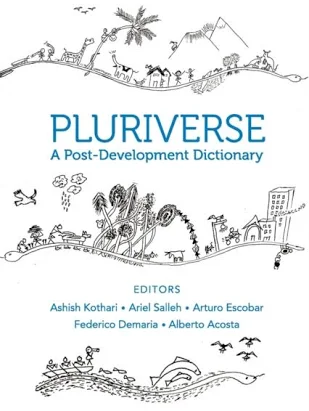
The Pluriverse is an alternative to this hegemony. It is defined as "a world where many worlds fit" (Kothari et al., 2019, p. xxviii). It asserts that there is no singular path to human flourishing. Instead, reality is composed of a multiplicity of distinct, valid, and self-governing cultural and ecological cosmovisions.
The Pluriverse does not try to establish a new global standard; it defends the co-existence of distinct, localized frameworks. Some famous examples are:
Buen Vivir (Andes): Living in deep harmony with the Pachamama (Mother Earth), where nature possesses intrinsic rights, and human well-being is detached from material wealth accumulation (Kothari et al., 2019, p. 2).
Ubuntu (Southern Africa): The relational philosophy of "I am because we are," which extends accountability past human society and into ancestral lands and ecological webs (Kothari et al., 2019, p. 2).
Radical Ecological Democracy (South Asia): Direct, localized governance where communities make ecological decisions based on their immediate landscape's limits rather than corporate state demands (Kothari, 2014, p. 12).
Why We Implement Pluriversal Methods in Our Education
Activating Emotional Intelligence and "Interbeing"
Standard education treats the mind as an isolated processing unit, completely disconnected from emotional, somatic, or ecological realities. To break this conditioning, our educational design draws from Tool 5: Come To Your Senses of the landmark handbook Tools for Regenerative Practice (Buckton, Fazey, Sharpe, & Wahl, 2026, p. 51).
We instruct our participants to step away from analytical text and systematically cycle through their physical senses in our immediate landscape (p. 55). This exercise activates intuitive and emotional intelligence, forcing learners to move past the abstract concept of sustainability and directly experience what indigenous cosmovisions define as "interbeing"—the reality that we are a relational entity embedded within a living web of non-human life (pp. 12, 51).
Disorienting the Desire for Colonial Certainty
Modernity conditions us to demand quick fixes, absolute certainty, and comfortable, linear solutions to complex problems. As decolonial educator Dr. Vanessa Machado de Oliveira notes, this desire for comfort often prevents us from sitting with the real, messy responsibilities of systemic collapse (Oliveira, 2021, p. 14).
Our educational architecture deliberately embraces friction and hands-on, non-linear experimentation. Whether managing a shared compost heap, troubleshooting a localized solar grid, or navigating interpersonal tensions within the community, our learning spaces are environments where participants must practice relational resilience and collective maturity in the face of uncertainty.
Reclaiming "Epistemic Freedom"
We practice what decolonial theorist Dr. Sabelo Ndlovu-Gatsheni terms epistemic freedom, reclaiming the right to learn from diverse intellectual lineages outside Global North academies (Ndlovu-Gatsheni, 2018, p. 3).
Our curriculum values localized, generational, and indigenous technologies, such as traditional food preservation, seed-saving, or nature-based architecture, on equal footing with modern Western ecology. We teach our students that ancestral solutions are not historical artifacts; they are advanced, highly sophisticated models of long-term climate adaptation.

How the Pluriverse Relates to the "New Pirate Economy"
Theory without structural application is hollow. At The Adventures of the Valparaíso, our educational architecture uses the Pluriverse as its internal worldview and the New Pirate Economy as its external, practical laboratory.
Historically, pirates did not just raid trade routes; they actively defied imperial state monopolies, organized their vessels under highly democratic, egalitarian crew constitutions, and built autonomous networks entirely outside the legal and financial frameworks of empires. The New Pirate Economy applies this subversive spirit to modern economic transition through three distinct pillars:
Committing Acts of Decommodification
The capitalist "Universe" asserts that you must earn money to purchase your basic survival from commercial corporations. The New Pirate Economy uses pluriversal education to teach decommodification—the direct act of clawing your survival back from the market.
Our interns learn to practice Tool 10: Unique Gifts of Life (Buckton et al., 2026, p. 75). By physically tracing the deep socio-ecological lineage of things entering our space, we unlearn the habit of looking at resources as cheap commodities (p. 76). We replace them with shared tool libraries, collective seed banks, and non-monetary skill exchanges. When a family learns to feed, house, and repair itself through shared infrastructure, it stops feeding resource-intensive industrial production.
Establishing Collective Provisioning Over Corporate Monopolies
As degrowth economists Dr. Giacomo D'Alisa and Dr. Giorgos Kallis explain, a post-growth society cannot survive on lifestyle changes alone; it requires collective provisioning—building community-managed infrastructure to meet fundamental human needs outside market dependency (D'Alisa et al., 2014, p. 23).
In our educational methodology, the site itself acts as a living commons. Students do not just read about degrowth; they run alternative provisioning systems. They practice what eco-feminist Silvia Federici calls the defense of the reproductive commons, treating daily care labor—such as cooking, cleaning, maintenance, and soil-tending—as the foundational, self-governing value of human organization (Federici, 2012, p. 2).
Practicing Bioregioning
Finally, the New Pirate Economy operates through bioregioning—decoupling from globalized, high-throughput supply lines and re-anchoring community logistics within localized social and ecological boundaries (Buckton et al., 2026, p. 115; Wahl, 2016, p. 41). Our pedagogy transforms participants from passive "residents" who merely consume resources inside a geographic space into active "inhabitants" who belong to and defend their immediate watershed, soil webs, and community mutual aid networks (Wahl, 2016, p. 41).

The Global Immune Response: Why the Transition Must Be a Network
A common mistake is assuming that localization or degrowth means complete isolation—a world of fragmented, inward-looking communities. This is an ecological and social impossibility. A true regenerative transition requires a global, interconnected network of autonomous communities for three structural reasons:
Socio-Metabolic Interdependence
In ecological economics, no localized community can form a completely closed loop. Watersheds flow across political lines, migratory species travel across hemispheres, atmospheric carbon moves globally, and nutrient cycles rely on wide geographical distribution. If one localized valley practices perfect ecological regeneration but the neighboring valley dumps toxic runoff into the shared river, the first valley's regeneration fails.
Therefore, local communities must form ecosystem-to-ecosystem networks to govern shared ecological commons. Regeneration is not a static local state; it is an active, cross-boundary alignment with the self-renewing, fluid cycles of nature (Buckton et al., 2026, p. 11).
Countering "Green Colonialism"
Right now, the Global North's attempt at "sustainability" relies heavily on shifting ecological damage to the Global South. For example, producing an electric vehicle to lower carbon emissions in Europe requires intensive extraction of lithium and cobalt, which devastates watersheds in South America and the Democratic Republic of Congo (Hornborg, 2019, p. 73).
A localized community in the Global North cannot claim to be "regenerative" if its solar panels, tools, or clothing are sourced from extractive corporate supply lines that destroy another community’s Pluriverse. A global, horizontal network allows communities to coordinate directly with one another on the basis of reciprocity and anti-imperialism, preventing any one region from achieving environmental purity at the expense of another.
Structural Defection and Translocal Solidarity
A single, isolated autonomous community attempting to break away from corporate capitalism is easily crushed, co-opted, or starved out by market forces. For an alternative economic paradigm—like the New Pirate Economy—to survive, it requires a decentralized network of mutual aid.
This is what the Zapatistas call Translocal Solidarity. When communities link horizontally, they create a parallel, non-capitalist global architecture. If one community experiences a climate shock, the larger network acts as a decentralized safety net—supplying heirloom seeds, shared labor, and ecological knowledge through gift-economy circuits rather than exploitative market loans.
This connects directly with Tool 11: Recognizing Practices of Care from the regenerative handbook (Buckton et al., 2026, p. 82). When communities recognize that the "caring impulse of life" is a universal biological reality, they realize that their local struggles for land stewardship and decommodification are part of a shared global immune response against an extractive system (pp. 82, 87).
Setting Sail: The Horizon of a Pluriversal Future
Designing educational architecture for the Pluriverse means training people to become economic dissidents, community custodians, and humble co-evolvers with the living world.
By anchoring our non-formal education in sensory awareness, epistemic diversity, and relational resilience, we do not simply prepare our participants to find a place within the existing system. We give them the tools, the community infrastructure, and the pirate audacity to build alternative, autonomous worlds right where they stand.
Join us in this pluriversal journey!

References
Barca, S. (2020). Forces of reproduction: Notes for an eco-feminist decolonial hegira. Cambridge University Press.
Buckton, S., Fazey, I., Sharpe, B., Wahl, D., Adams, D., Bayoneta, C., Belzer, A., Chaplowe, S., Colvin, J., Crossland, A., Everson, R., Eyre, L., Fearnley, J., Fletcher, B., Fraser, H., Hughes, V., Jackson, D., Leicester, G., Lovett, A., . . . Smee, C. (2026). Tools for regenerative practice: 30 frameworks, exercises and methods in service of human and planetary flourishing. FixOurFood and Ecocentric Futures. https://doi.org/10.5281/zenodo.19666677
D'Alisa, G., Demaria, F., & Kallis, G. (Eds.). (2014). Degrowth: A vocabulary for a new era. Routledge.
Escobar, A. (2018). Designs for the pluriverse: Radical interdependence, autonomy, and the making of worlds. Duke University Press.
Federici, S. (2012). Revolution at point zero: Housework, reproduction, and feminist struggle. PM Press.
Hornborg, A. (2019). Nature, society, and justice in the Anthropocene: Unraveling the money-energy-technology nexus. Cambridge University Press.
Kothari, A. (2014). Radical ecological democracy: A path for India and the world. Alternatives.
Kothari, A., Salleh, A., Demaria, F., Acosta, A., & Escobar, A. (Eds.). (2019). Pluriverse: A post-development dictionary. Tulika Books.
Ndlovu-Gatsheni, S. J. (2018). Epistemic freedom in Africa: Deprovincialization and decolonization. Routledge.
Oliveira, V. M. de. (2021). Hospicing modernity: Facing humanity's wrongs and the implications for social activism. North Atlantic Books.
Wahl, D. C. (2016). Designing regenerative cultures. Triarchy Press.
About the Author: Prisca Braga is a non-formal educator, researcher, and member of the Anchor Team at The Adventures of the Valparaíso, where she shapes the association’s educational architecture and vision. Currently pursuing a Master’s in Global Political Economy and Development at the University of Kassel, she weaves together network building, program design, and systemic transition. Guided by political ecology, degrowth, and decolonial approaches, Prisca is dedicated to building regenerative learning spaces that help communities organize and thrive beyond extractive economic models.