Written by Prisca Braga | Reading Time: 10 mins
If you follow alternative economics or ecological activism, you have likely noticed a major shift in vocabulary. Words like “sustainability” and even “circular economy” are increasingly giving way to a much deeper imperative: Regeneration.
But what does regeneration actually mean when we strip away the marketing buzzwords? Today we will work with a handbook titled Tools for Regenerative Practice: 30 Frameworks, Exercises and Methods in Service of Human and Planetary Flourishing provides a nice blueprint. Co-authored by Sam Buckton, Ioan Fazey, Bill Sharpe, and Daniel Wahl (2026), this guide bridges the gap between macroeconomic system transformation and our direct relationship with the living world, and gives us very practical tools to live more regeneratively.
The Core Concept: Regenerative vs. Circular
Before looking at actions, we have to understand the foundational theory. Most sustainable lifestyle guides focus on "closing the loop", the core idea of the circular economy. While circular strategies are valuable for minimizing waste and maximizing energy efficiency, the Tools for Regenerative Practice handbook reminds us that regeneration goes a step further.
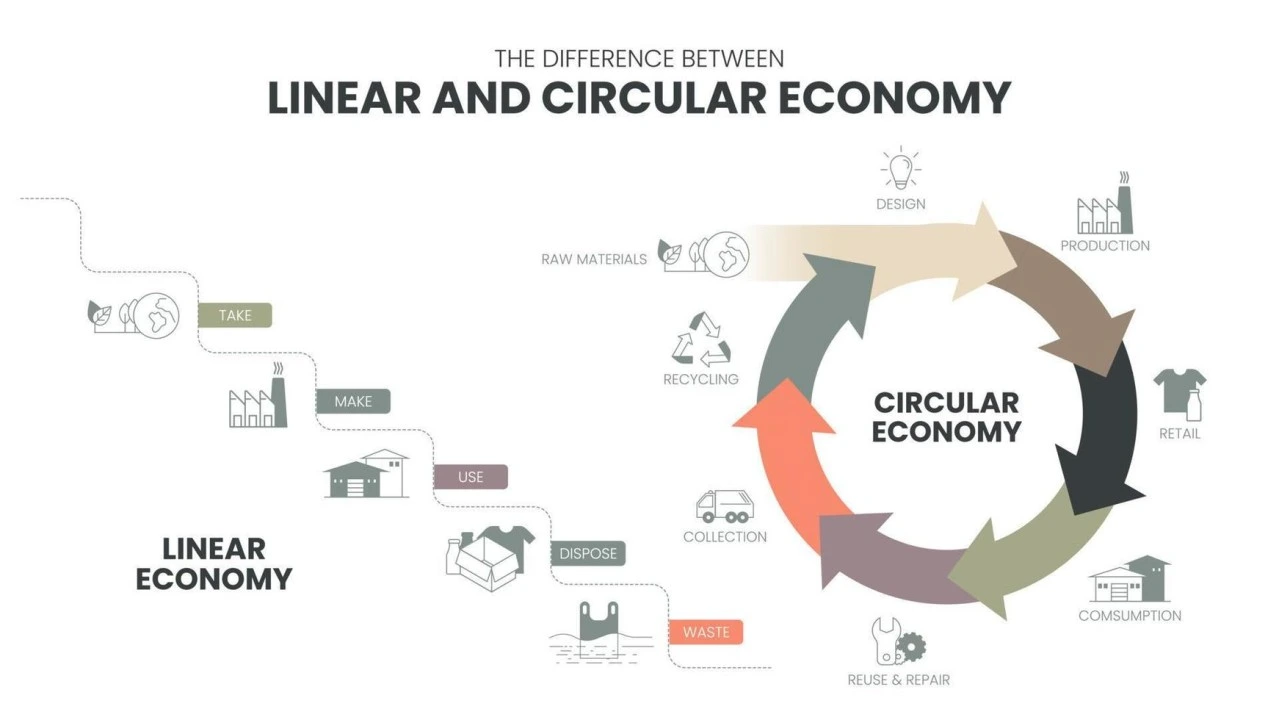
A circular economy focuses on managing materials and energy to reduce environmental damage. Regenerative practice, on the other hand, actively restores and enhances the capacity of both ecosystems and human communities to co-evolve and flourish together (p. 9). As the pioneering biomimicry thinker Janine Benyus famously summarized: "Life creates conditions conducive to life".
Regeneration means shifting from a mindset of reducing damage to the planet to a continuous, lived process of aligning human activity with the self-renewing cycles of nature itself (p. 11). Furthermore, the authors humbly emphasize that this is not a new Western invention; it is a rediscovery of ecocentric paradigms, biocentric worldviews, and ancestral practices of care that Indigenous cultures have maintained since time immemorial (p. 11).
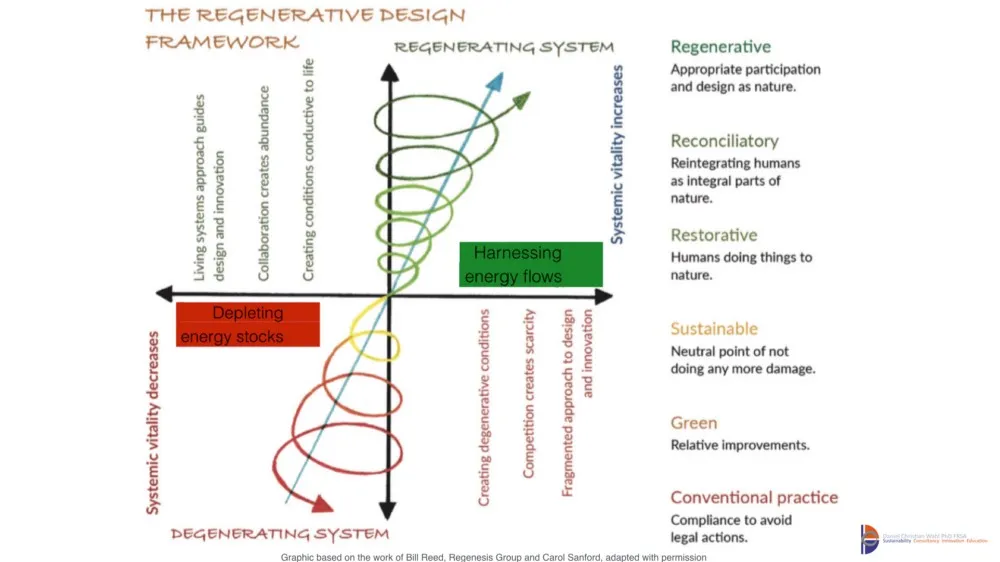
Image by Daniel Christian Wahl
How do we embody this shift? The guide points out that true regenerative practice isn't just an intellectual exercise; it requires engaging our whole-body senses, emotional reasoning, and practical, hands-on action (p. 12).
Grounding Your Individual Life: Downsizing and Sensory Awareness
The first level begins with the self. Modern urbanized societies steep us in a deep historical illusion of human-nature separation, causing us to treat the environment as a transactional asset or merely a place we visit.
To counter this, ecological economics introduces the concept of social metabolism, the total volume of energy and raw materials a household extracts, processes, and ejects as waste. True post-growth living requires a planned downscaling of this throughput, moving beyond green technology toward absolute reduction.
Knowing Your Backyard and Tracing Web Values
Within our households and families, and communities, we can scale individual awareness into active, relational systems thinking. Modern development conditions us to view globally shipped, commodified goods as immediate necessities, completely severing our awareness of where our food, water, and utilities originate.
Transitioning your household means shifting from being a mere resident who occupies a space and consumes its resources to becoming an inhabitant who belongs to a specific bioregion and participates in its ecological health (Wahl, 2016, p. 41).
Putting it into practice:
Map Your Bioregion: Sit down as a household and learn the concrete boundaries of your local watershed. Find out exactly where your tap water originates and where your household wastewater drains. Identify native plant species, migratory birds, and the seasonal biological shifts in your immediate area.
Trace the Unique Gifts of Life: Adapt Tool 10 from the handbook to alter your household’s relationship with material goods (Buckton et al., 2026, p. 75). Choose an item entering your home, like a basket of vegetables, a cotton shirt, or a piece of furniture, and collectively map its socio-ecological lineage. Trace the soil that grew it, the water cycles that fed it, and the human hands that processed it (p. 76).
Practice Bioregional Provisioning: Step away from corporate grocery networks and re-embed your household in localized food webs, community-supported agriculture (CSAs), and urban foraging networks. As post-development scholar Ashish Kothari advocates in his framework of Radical Ecological Democracy, true sustainability is rooted in families engaging in direct, localized stewardship of their food, water, and immediate ecological commons (Kothari, 2014, p. 12).
Grounding Your Community: Sharing Infrastructure and Mapping Practices of Care
Capitalism thrives by isolating us. When every single household on a street is structurally forced to buy its own isolated appliances, tools, and vehicles, the GDP grows, but ecological systems collapse under the weight of industrial production.
To reverse this, degrowth thinkers call for collective provisioning: meeting fundamental human needs through shared, non-market community infrastructure rather than private corporate dependency (D'Alisa et al., 2014, p. 23).
Putting it into practice:
Establish a Local Commons: Gather your neighbors, friends, or local community organizations to audit what you collectively own. Build localized tool libraries, shared seed banks, or community equipment sheds. By decommodifying high-utility items, you drastically lower your community's collective demand for newly manufactured goods.
Map Existing Practices of Care: Use Tool 11 in the handbook to recognize that community regeneration need not be built entirely from scratch (Buckton et al., 2026, p. 82). Take an eight-sectored view of your neighborhood to identify where the "caring impulse of life" is already operating (p. 82). Locate the informal mutual aid networks, the volunteer community kitchens, the eldercare circles, and local repair initiatives (p. 82).
Reclaim the Labor Economy: Link up with these existing networks of care to build regional resilience (Buckton et al., 2026, p. 87). Establish non-monetary time banks or skill shares where neighbors exchange labor, such as carpentry, food preservation, or childcare, based on mutual needs rather than financial transactions. As eco-feminist Silvia Federici argues, capitalism systematically devalues reproductive care labor because it doesn't generate corporate profit; centering your community around these care networks is an act of structural defiance (Federici, 2012, p. 2).
Relearning Autonomy
Living regeneratively is a collective, structural process of stepping off the hamster wheel of infinite growth.
By starting with individual sensory grounding, shrinking our socio-metabolic footprint, organizing bioregionally within our households, and defending the local commons with our neighbors, we move past sustainability. Guided by the fundamental question highlighted by the pioneers of regenerative practice, we learn to ask: What serves life—in me, around me, and through me? (Buckton et al., 2026, p. 7).
We begin laying the groundwork for a post-growth pluriverse, built from the soil up. Want to do this together? Join us!
References
Barca, S. (2020). Forces of reproduction: Notes for an eco-feminist decolonial hegira. Cambridge University Press.
Buckton, S., Fazey, I., Sharpe, B., Wahl, D., Adams, D., Bayoneta, C., Belzer, A., Chaplowe, S., Colvin, J., Crossland, A., Everson, R., Eyre, L., Fearnley, J., Fletcher, B., Fraser, H., Hughes, V., Jackson, D., Leicester, G., Lovett, A., . . . Smee, C. (2026). Tools for regenerative practice: 30 frameworks, exercises and methods in service of human and planetary flourishing. FixOurFood and Ecocentric Futures. https://doi.org/10.5281/zenodo.19666677
D'Alisa, G., Demaria, F., & Kallis, G. (Eds.). (2014). Degrowth: A vocabulary for a new era. Routledge.
Federici, S. (2012). Revolution at point zero: Housework, reproduction, and feminist struggle. PM Press.
Hornborg, A. (2019). Nature, society, and justice in the Anthropocene: Unraveling the money-energy-technology nexus. Cambridge University Press.
Kothari, A. (2014). Radical ecological democracy: A path for India and the world. Alternatives.
Wahl, D. C. (2016). Designing regenerative cultures. Triarchy Press.
About the Author: Prisca Braga is a non-formal educator, researcher, and member of the Anchor Team at The Adventures of the Valparaíso, where she shapes the association’s educational architecture and vision. Currently pursuing a Master’s in Global Political Economy and Development at the University of Kassel, she weaves together network building, program design, and systemic transition. Guided by political ecology, degrowth, and decolonial approaches, Prisca is dedicated to building regenerative learning spaces that help communities organize and thrive beyond extractive economic models.